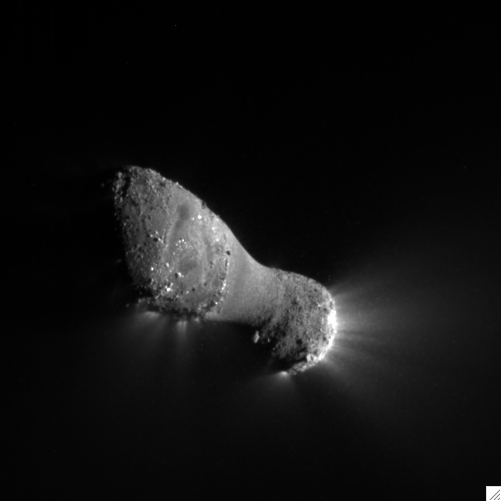
Comet???
Not in a traditional “dirty snowball” sense. This is an outdated term. But I do remember this term from years ago when comets were a theoretical thing. We are now visiting them.
Comet Hartley 2 looks like an Asteroid.
The out gassing is claimed to be CO2. It maybe water vapor also.
Preliminary observations.
This asteroid underwent a violent process. It seems like a movement of molten mass that cooled and solidified. This explains the smooth area.
Origins of this asteroid is most likely the asteroid belt. Millions of asteroids.
Try to visualize this, take a hot molten spherical mass - an irregular blob. A spinning blob (It is rotating at a 18 hour period - I am assuming end over end). As this blob spins, it begins to elongate due to centripetal forces - ok stretch. As this molten blob cools, it solidifies rapidly to the shape we see.
So, we are seeing something quickly frozen in time and it’s traveling at speed.
Original image. My source image. A reduced size, noisy image. I am certain there are better images in private. Color images.
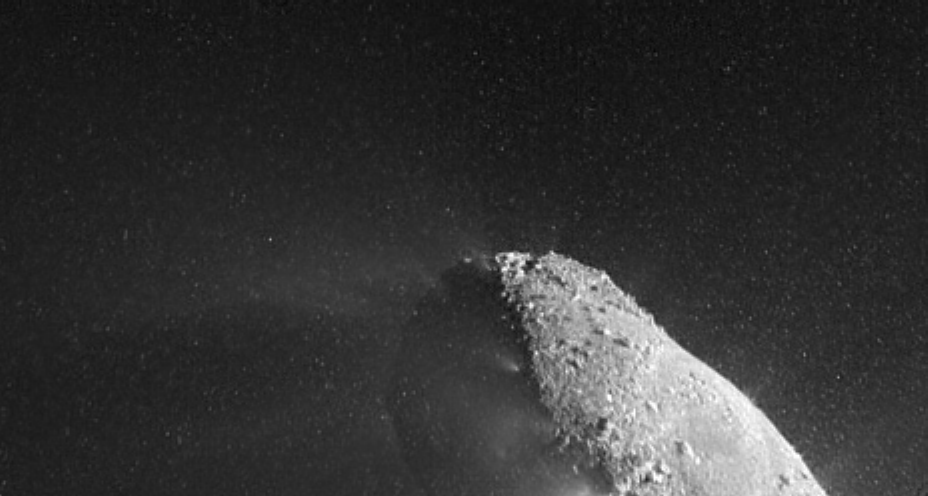
The Deep Impact spacecraft does have color filters. This is a good decent 12 inch diameter telescope/camera.
http://deepimpact.umd.edu/tech/hri.html
Better. Very busy. I can see this in the original noisy image. Artworks or sculpture. Maybe custom made just for this encounter by the Deep Impact spacecraft.

Another image. Note enhanced area. Something of a technological nature or process is shown here.
http://marsesa.9f.com/slide_shows/Hartley/20101118_AHearn1b_E2A.jpg
An area of interest. Very noticeable.

A reflected view. A constant theme, half portraits.

A couple of questions. Two possibilities.
1. This Asteroid/Comet is occupied by choice. “They” like to live there. Free to come and go as they please.
2. “They” are trapped on this Asteroid. (Why would anyone live on a Asteroid hurling thru space?).
Supposedly, this Asteroid/Comet will break up in another 700 years.
“Barring a catastrophic breakup or major splitting event, the comet should be able to survive up to another 100 apparitions (~700 years) at its current rate of mass loss.”
http://en.wikipedia.org/wiki/103P/Hartley
http://epoxi.umd.edu/index.shtml


No comments:
Post a Comment